

How Do Terminals Get More Value from the Investments They’ve Already Made?
TOC Europe has always been a good indicator of where the terminal industry is headed. After my second TOC Europe, one thing feels clear: the conversation around terminal technology is evolving.
Not because of a single product launch or announcement, but because of the questions people are asking.
Just last year in Rotterdam, many discussions centered on automation itself. This year, the focus seemed to shift toward a different challenge: how do terminals get more value from the investments they’ve already made?
Across sessions, customer conversations, and panel discussions, there was a recurring theme: measurable operational outcomes. The industry isn’t talking about what’s possible anymore. It’s talking about what works, what improves throughput, and what creates tangible operational value.
One comment that stayed with me came from Paul Saraber of Rotterdam World Gateway. He described the challenge not as a space constraint, but as a flow constraint.
That distinction matters.
From Capacity Expansion to Flow Optimization
If space is the problem, the answer is often more infrastructure.
If flow is the problem, the answer lies in better coordination, planning, and decision-making.
That shifts the conversation from expansion to optimization.
What struck me was that once I heard Paul frame the challenge that way, I started hearing versions of the same idea everywhere.
Walking between sessions, speaking with customers, and listening to panel discussions, the language was different but the underlying challenge was often the same. Operators weren’t asking how to automate more. They were asking how to get more throughput from the infrastructure, equipment, and systems they already have.
During the panel that Kaleris and RWG co-presented on Day 2, Carlos Lopez Barbera, VP, Maritime Solutions at Kaleris, spoke about how innovation is increasingly happening in brownfield terminals. These are operations that cannot simply start over with a blank slate. They need to improve performance while continuing to manage growing volumes, increasing complexity, and rising customer expectations.
Later, in a separate session, the conversation turned to digital twins. What stood out wasn’t the technology itself but how the discussion has evolved. A few years ago, digital twins were often presented as visualization tools. Now they’re increasingly being discussed as tools for operational decision-making, resilience, and scenario planning.
By the second day, a pattern had emerged.
Whether the topic was automation, optimization, AI, digital twins, or planning tools, the most interesting conversations weren’t centered on the technology. They were centered on outcomes. Better yard flow. Faster decisions. Improved utilization. Greater operational resilience.
The message was remarkably consistent: technology creates value when it’s embedded into daily workflows, not simply when it’s implemented.
Turning Data Into Operational Decisions
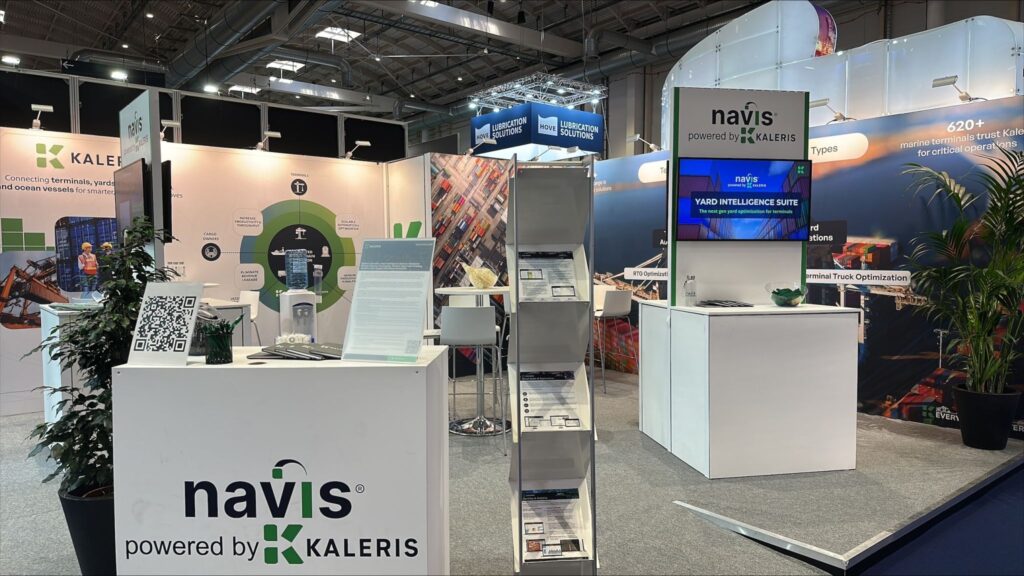
Those conversations reinforced why we launched Yard Intelligence Suite (YIS) at TOC Europe.
Over the past year, we’ve heard a common challenge from terminal operators: planners are managing increasingly complex operations while piecing together information from multiple systems, reacting to issues after they occur, and balancing competing priorities under constant pressure. The gap isn’t usually infrastructure -it’s decision support.
As part of Kaleris’ Advanced Optimization portfolio, YIS is designed to help terminals improve yard flow, increase throughput, and make smarter operational decisions combining optimization capabilities with AI-assisted recommendations. Rather than replacing human expertise, it’s designed to augment it: helping planners identify bottlenecks earlier, evaluate options faster, and act with greater confidence.
It’s the kind of tool that wouldn’t have resonated the same way a few years ago. But in Hamburg, it fit directly into the conversation already happening.
What the Next Phase is Really About
Modern terminal operators aren’t looking for technology for technology’s sake. They’re looking for ways to increase throughput, improve asset utilization, reduce unnecessary moves, and make better decisions, without adding more land, equipment, or headcount.
The technology exists. The proof points are growing. The real work now is helping terminals close the gap between the systems they have and the outcomes they’re trying to achieve.
Because in most cases, the constraint isn’t always what’s missing in operations, it’s what’s getting in the way of flow.
Achieve Superior Yard Control With Yard Intelligence
Tackle unpredictability with software that enables you to handle the chaos. Predict the next move for your yard by optimizing container placement decisions in advance and minimizing future rehandles with predictive intelligence built to support your workforce.