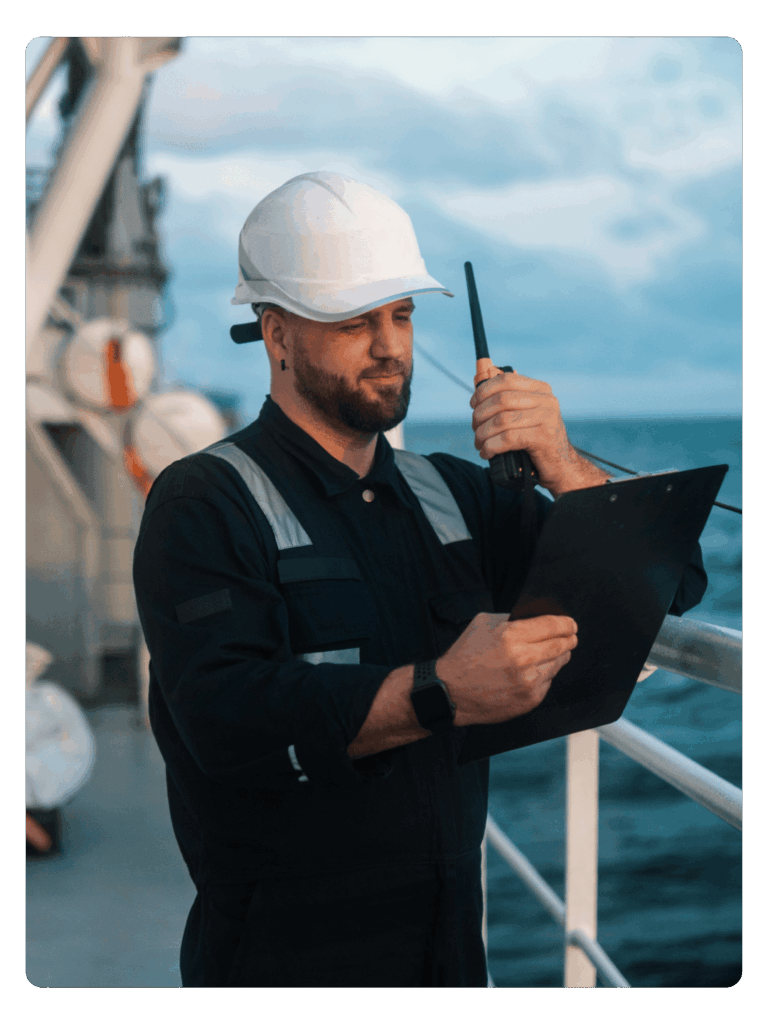
“Ship operating companies often hit a spot in their growth journey when they struggle to track where money is going, how to make cost control traceable, and forecasting always seems difficult.”
Sound familiar?
When different departments follow their own practices and use siloed software solutions, it leads to inconsistency, errors, and difficulty enforcing procurement policies. Transactions happen outside approved systems, organizations struggle to track where money is going, and cost control is reduced to a tedious deluge of emails and phone calls. Reliable forecasting is often limited by different sources of truth: heavy reliance on emails, spreadsheets, and paper invoices increases cycle times, raises processing costs, and swallow momentum.
So how should fleet managers tackle the rapid rise in volume without compromising operational efficiency?
Enter the Magic Wand
The magic wand seems to be Procure-to-Pay (P2P, Purchase-to-Pay, Self-Billing), the end-to-end business process that covers how an organization requests, purchases, receives, pays for, and records goods or services. It typically starts with a purchase requisition, moves through supplier selection and purchase order creation, and continues with receiving goods, invoice processing, and payment. The goal of P2P is to ensure spend control, operational efficiency, and financial accuracy while maintaining strong supplier and customer relationships. By standardizing and automating these steps, shipping networks can reduce costs, improve compliance with procurement policies, gain visibility into spending, improve the quality of invoices, and shorten payment cycles.
The Magic Wand Applied to Shipping Operations
However, integrating procure-to-pay into the operations of a shipping line relies heavily on aligning procurement and finance processes with the realities of fleet operations, port activities, and global supplier networks.
As shipping lines have decentralized, asset‑heavy operations, their P2P should be designed around events in key operational areas like fleet operations by looking into the procurement of fuels, spare parts, lubricants, safety equipment, and maintenance services and be closely linked to vessel schedules and planned maintenance systems. When it comes to port and terminal operations, port services such as stevedoring, pilotage, towage, port fees, and waste disposal should flow through standardized service orders, which are tied to the specific port call.
Effective P2P integration depends on connection with a shipping company’s planned maintenance system, fleet management system, voyage planning system, and the ERP / finance systems.
Integrating P2P into operations enables spend tracking by vessel, voyage, port, and cost category, identification of cost variances (e.g., bunker prices, port fees) and better budgeting and forecasting tied directly to operational activity. This is critical for margin management in today’s volatile shipping market.
An embedded P2P can especially facilitate smart financial operations around a port-call.
- Early demand capture enables spend control before the vessel arrives, and PO-backed services reduce disputes and support invoice matching.
- Service delivery execution, operational confirmation, possible emergency buys – in all these fields P2P supports an overview of controlled exceptions without blocking operations.
- Accurate consumption data improves accounting and cost allocation;
- Clean service confirmation reduces invoice delays,
- Automated matching invoices minimize disputes and manual rework. A timely payment, based on matched and exception-cleared invoices, strengthens agent and port supplier relationships.
An integrated Purchase-to-Pay improves cost predictability, reduces post‑voyage disputes, enables real‑time voyage P&L and balances the speed of operations with financial control.
For a shipping line, P2P works best when it is embedded into daily operations, tightly integrated with fleet and port systems, and flexible enough to support global, fast-moving activities. Done right, it improves cost control, operational efficiency, compliance, and supplier performance—without slowing the ships down. The smartest way of embedding P2P for a shipping line is to have it as a part of the ERP system, and this is exactly what Kaleris Odyssey provides.
Kaleris Odyssey Self-Billing Module
The Odyssey “Self-Billing” Module replaces terminal invoice processing with automated validation, provides real‑time cost accrual accuracy for forecasting and reporting, maintains tariff tables, ensures adherence to contract‑based rates and uses accurate event‑driven costs for margin, pricing and profitability decisions.
It enhances cost transparency and strengthens cost control across all terminal‑related activities by:
1. Increasing contract compliance by ensuring all supplier commitments follow approved contracts and the correct stakeholder approval flow.
2. It achieves 90%+ PO coverage and streamlines the process of raising purchase orders and executing self‑billing.
It also standardizes the end‑to‑end invoice process — receiving, registering, approving, and paying — to eliminate variations and inefficiencies and to implement a unified supplier onboarding process to ensure consistent data, controls, and compliance. Roles and responsibilities are clarified across the entire P2P chain to reduce ambiguity and strengthen accountability.
Customers with a fleet of 15-20 vessels report annual savings of over 2 M USD from gaining more clarity and control over actual handlings per port, storage costs according to latest contracts and control over actual reefer costs.
The Self‑Billing capability is delivered as a standard Odyssey module which connects with Odyssey Cost/Tariff and Odyssey Events to automatically create accurate self‑billing cost lines from event data at contracted rates.