
When the Yard Keeps Changing, Planning Can't Stay Static
A terminal yard rarely follows a fixed pattern.
Container flows change, dwell times shift, vessel schedules move, and yard density can rise and fall throughout the day. A strategy that works well in one situation may not be the right approach when conditions change.
This is something we hear from terminal planners regularly:
“If the yard is constantly changing, how can the system keep up?”
It is a fair question. The answer cannot simply be to ask planners to continuously monitor every little change and manually adjust every strategy. As the yard becomes more dynamic, that approach can add significant workload to the people who are already responsible for keeping operations moving.
The real opportunity is to make planning responsive and proactive enough to handle changing conditions without making the planner responsible for every adjustment.
Planning the Yard Shouldn't Mean
Constantly Replanning It
Traditional planning approaches often rely on predefined strategies and manual intervention. A planner defines the rules, monitors what is happening in the yard, identifies when conditions have changed, and then decides whether the strategy needs to be adjusted.
This can work when conditions are relatively stable. But yards are not always predictable.
So what happens when the number of possible scenarios increases, and planners cannot realistically configure a strategy for every one of them?
This is where intelligent planning can change the way the planner interacts with the system. Instead of manually defining every possible adjustment, the system can help generate an appropriate strategy based on the planner's objectives, instructions, and operational constraints related to the terminal.
The planner still makes the decision, but the system takes on more of the work required to arrive at that decision.
From Manual Configuration to Guided Decision-Making
Kaleris Yard Intelligence Suite (YIS) is designed around this principle.
Planners do not need to manually configure every strategy for every possible scenario. Through a guided wizard, they can provide their objectives and instructions, while the system uses those inputs to generate a strategy automatically.
The planner can then review the proposed strategy, make any necessary changes, and confirm it before it is applied.
This creates a more practical approach to AI-augmented decision-making. AI is not making decisions independently or taking the planner out of the process. Instead, it helps process the complexity involved in developing a strategy, allowing planners to spend less time on configuration and more time reviewing and making decisions that require their expertise.
Making Strategy Responsive to the Yard
Consider decking as an example. A planner may want containers to be positioned according to specific operational priorities, but those priorities can change as conditions in the yard change. Manually monitoring those conditions and switching strategies each time can quickly become another task for the planner to manage.
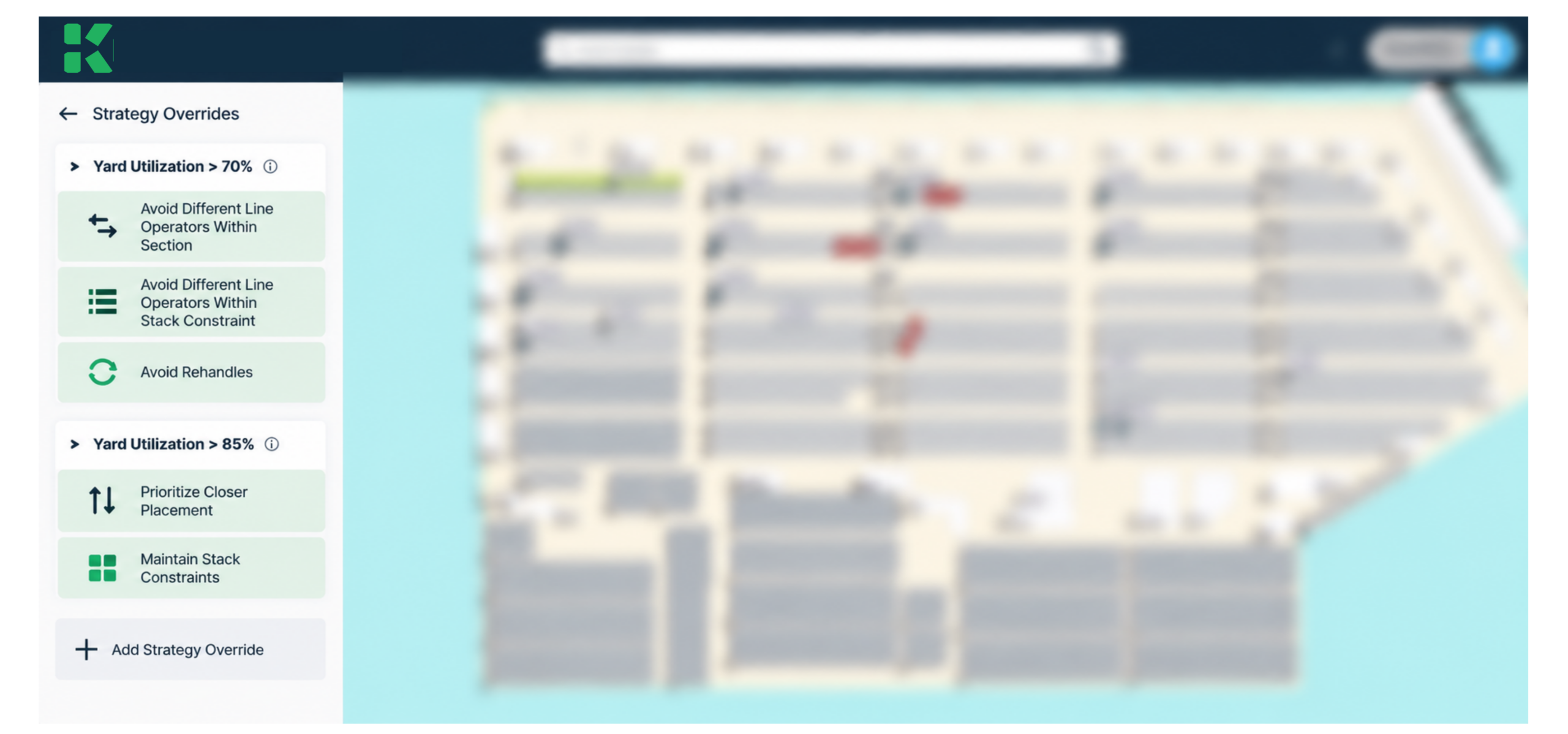
With Intelligent Decking and Auto Switch, planners can provide instructions for how the decking strategy should respond to different conditions. The system can then automatically switch between defined strategies as those conditions change.
This allows the planner to establish the intent and the boundaries, while the system responds to the conditions within them. The planner remains at the centre of the process, but does not need to manually intervene every time the yard changes.

Illustrative representation. Contact us for a closer look.
Knowing When the Yard Needs Attention
Adapting the strategy is only part of the challenge. Planners also need to understand when conditions in the yard are beginning to move away from what is expected and where their attention may be needed.
This is where the Yard Health Monitor provides another layer of support. Rather than requiring planners to piece together different operational signals themselves, it can highlight areas or conditions that may require attention.
The objective is not to give planners another screen to constantly monitor. It is to help them understand the overall health of the yard and focus their attention on the areas where intervention may have the greatest impact and provide recommended actions.
The decking analysis agent adds another layer of insight by analyzing decking results and patterns, helping identify potential problem areas, explain what may be driving them, and suggest possible actions for planners to consider.
From Managing Rules to Managing Outcomes
As yards become more dynamic, manually managing every rule and adjustment becomes increasingly difficult. The answer is not to remove the planner from the process, but to give them a system that can adapt to changing conditions while working within the objectives and constraints they define.
This creates a different model of planning. The planner sets the objective and provides the operational context. The system uses that information to develop and adapt strategies, while the planner reviews and validates the decisions.
The result is a planning environment where more of the routine complexity can be handled by the system, allowing planners to focus their time and expertise where it matters most.
That is ultimately what intelligent yard planning should deliver. It is not simply about automating more tasks. It is about reducing the manual effort required to keep planning aligned with a yard that is constantly changing, while keeping the planner firmly in control.

“When the yard changes constantly, how can planning adapt without putting more work on the planner?”
Terminal yards are constantly in flux – container flows shift, vessel schedules change, and density rises and falls throughout the day. Traditional planning approaches ask planners to manually monitor every change and adjust strategies accordingly, adding significant workload to teams already stretched thin. But what if the system could adapt to changing conditions while keeping the planner in control? Discover how intelligent yard planning is shifting the role from managing rules to managing outcomes – reducing manual effort without removing human expertise from the process.
Beyond Cargo Tracking: How General Cargo TOS Is Turning Operational Data Into Business Value
General cargo operations are getting more complex – but your TOS shouldn’t just tell you what happened. It should help you understand what’s happening now, what needs to happen next, and how every move translates into business value. From real-time visibility to AI-assisted planning, the terminal of the future isn’t one where humans disappear, it’s one where technology helps operators make better decisions, faster.
From Message Exchange to Shared Truth : Unlocking Optimization in Cargo Operations – Part 3
The maritime industry doesn’t lack data – it lacks agreement on what’s actually happening. Exchanging information isn’t the same as sharing a common understanding, and today’s systems communicate intent rather than reality. The Kaleris Cargo Data Exchange Hub bridges this gap by connecting shipping lines, vessels, ports, and terminals into a single, synchronized data environment where all parties operate from the same source of truth – enabling true optimization through coordination, not just communication.