
The next generation of terminal technology won’t be defined simply by how much of the operation can be automated.
It will be defined by how intelligently the operation can respond to change.
That was one of the central themes of the Kaleris webinar, Turning Innovation into Operational Value with Kaleris General Cargo TOS.
The discussion moved beyond today’s TOS capabilities to explore what comes next: more flexible integrations, configurable workflows, smarter work order management and the potential for artificial intelligence to support real-time operational decision-making.
The vision is not a terminal where technology replaces people.
It is a terminal where technology gives people better information, better recommendations and less manual work to manage.
The terminal can't afford to
be rigid
Terminal operations change constantly.
Volumes fluctuate. Cargo mixes change. Seasonal peaks create new pressures. Customer requirements evolve. New systems need to connect to existing infrastructure.
A TOS that requires a major system overhaul every time the business changes can quickly become an operational limitation.
That's why configurability matters.
As discussed during the webinar, core processes such as yard allocation, vessel planning, gate workflows and billing can be configured to adapt to changing requirements. Operational teams can also adjust thresholds, priorities and service profiles without necessarily relying on the vendor for every change.
The objective is straightforward:
“It really comes down to being a simple configuration exercise as opposed to needing a time consuming system overhaul.”
For terminals, flexibility can mean less operational overhead and a faster response when business conditions change.
Integration shouldn't mean replacement
Modernization also doesn't necessarily mean throwing out everything that already exists.
General cargo terminals often operate within a technology ecosystem that includes ERP platforms, financial systems, gate solutions, legacy systems, customs platforms and other operational technologies.
The TOS needs to work within that ecosystem.
During the webinar, the Kaleris team discussed REST and JSON APIs, EDI, XML and other integration capabilities designed to support connections across operational and financial systems.
The philosophy is particularly important:
“You're not buying a closed system.”
Instead, the TOS can serve as an operational layer that extends existing systems rather than requiring terminals to replace everything around them.
That creates a more practical path toward modernization.
What happens when AI starts helping manage the work?
This is where the conversation gets especially interesting.
Today, work orders can help organize the tasks required to move and process cargo. Tomorrow, those workflows could become increasingly dynamic. The webinar explored the potential for AI to help move work orders beyond static lists toward self-optimizing workflows.
Rather than relying entirely on predefined rules, an AI-enabled system could potentially consider live operational conditions such as:
- Equipment positioning
- Queues
- SLAs
- Cargo arrival times
- Equipment downtime
- Dwell times
- Cycle times
- Operational disruptions
The system could then dynamically assign and sequence jobs based on those conditions. That changes the role of automation. Instead of simply automating a predetermined process, technology starts helping the operation adapt the process as conditions change.

Less manual reshuffling. More intelligent orchestration.
Anyone who has worked in a complex operation knows that the plan
rarely survives unchanged.
A truck is late.
Equipment goes down.
Cargo arrives earlier than expected.
A vessel schedule shifts.
An urgent customer request comes in.
Suddenly, supervisors are spending time reshuffling tasks and figuring out what needs to happen next.
AI could help reduce some of that manual replanning.
The webinar described a future in which AI could suggest actions such as revisiting task assignments or bundling work orders, allowing supervisors to focus less on building schedules from scratch and more on validating and improving the next best set of tasks.
That distinction is important. The goal isn’t to remove the supervisor. It’s to give the supervisor a better starting point.
AI still needs people in the loop
For all the excitement around AI, one of the strongest messages from the webinar was that intelligent automation still requires human judgment.
“We need human validation and we need smart people and people doing their job in order to make sure that
the right outcome is met.”
That’s particularly relevant in terminal operations. AI may be able to process information quickly and identify potential actions, but the operational environment is constantly changing.
The wrong recommendation doesn’t simply create a bad data point. It can create another bottleneck somewhere else in the cargo lifecycle.
The objective, therefore, isn’t to automate one task at the expense of another. It’s to make the entire cargo lifecycle more efficient.
Innovation has to show up in the real world
The webinar also demonstrated that innovation isn’t just about what a technology platform could do. It’s about what it actually helps terminals accomplish.
Across customer examples, the challenges were familiar:
- Legacy systems that weren’t scaling
- Manual operational processes
- Limited visibility
- Complex billing workflows
- Data that wasn’t flowing easily between systems
- Difficulty managing diverse cargo operations
In one Oceania customer example, modernization helped improve invoicing and billing, reduce manual intervention and improve visibility into voyage data, contributing to stronger operational efficiency and system reliability.
These examples reinforce an important point:
Digital transformation doesn’t have to begin with a futuristic use case.
Sometimes the biggest value comes from solving the operational friction that teams deal with every day.
The intelligent terminal will be adaptable
The future of general cargo technology isn’t a single destination. It’s an ongoing evolution.
Today’s priority may be better visibility. Tomorrow’s may be more configurable workflows. Then it could be AI-assisted planning, dynamic task orchestration or predictive decision support.
The technology foundation needs to be flexible enough to support that evolution.
Kaleris General Cargo TOS is designed to support different cargo types, regions and operational requirements through a scalable platform, with real-time visibility and configurable capabilities. The platform has been adopted across more than 100 terminals and supports multiple languages.
That scalability matters because the terminal of the future won’t necessarily operate the way today’s terminal does.
The technology needs to be ready to evolve with it.
The next move is smarter execution
The evolution of General Cargo TOS ultimately comes down to a simple idea:
Make the operation easier to understand, easier to adapt and easier to optimize.
AI can help.
Automation can help.
Integration can help.
Analytics can help.
But the real value comes when those capabilities work together around the people responsible for running the terminal.
The future isn’t about technology making every decision. It’s about technology helping operators make better decisions, faster.
Want to see how Kaleris is helping general cargo terminals turn innovation into operational value?
Watch the full webinar → Turning Innovation into Operational Value with Kaleris General Cargo TOS

From Automation to Intelligence: The Future of General Cargo Operations
The next generation of terminal technology won’t be defined by how much of the operation can be automated. It will be defined by how intelligently the operation can respond to change. Drawing on the Kaleris webinar Turning Innovation into Operational Value with Kaleris General Cargo TOS, this blog looks at configurable workflows, open integrations and AI-assisted work order management. Together, they point to a future where technology doesn’t replace people. Instead, it helps operators make better decisions, faster.
“When the yard changes constantly, how can planning adapt without putting more work on the planner?”
Terminal yards are constantly in flux – container flows shift, vessel schedules change, and density rises and falls throughout the day. Traditional planning approaches ask planners to manually monitor every change and adjust strategies accordingly, adding significant workload to teams already stretched thin. But what if the system could adapt to changing conditions while keeping the planner in control? Discover how intelligent yard planning is shifting the role from managing rules to managing outcomes – reducing manual effort without removing human expertise from the process.
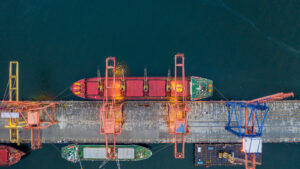
Beyond Cargo Tracking: How General Cargo TOS Is Turning Operational Data Into Business Value
General cargo operations are getting more complex – but your TOS shouldn’t just tell you what happened. It should help you understand what’s happening now, what needs to happen next, and how every move translates into business value. From real-time visibility to AI-assisted planning, the terminal of the future isn’t one where humans disappear, it’s one where technology helps operators make better decisions, faster.