A yard rarely becomes difficult to manage all at once.
It starts small. Density in the yard begins to rise. Container flows shift. A vessel schedule changes. A block fills faster than expected. None of it looks urgent at first. But as conditions keep shifting, space tightens, moves pile up, and planners are left with fewer options and less time to respond.
The challenge isn’t simply knowing what’s happening in the yard. It’s recognizing when today’s conditions are likely to become tomorrow’s problem.
By the time a constraint becomes visible, planners are often already working around it instead of preventing it. It didn’t appear suddenly. It was built up over time. So, the real question isn’t how fast a planner can react. It’s whether they can see the situation developing early enough to actually do something about it.
Today's Yard Tells You Where You Are. Not Where You're Heading.
Most of today’s TOS and operational tools give planners strong visibility into the current state of the yard, but it has limits. It doesn’t necessarily tell planners:
- Where pressure is likely to build next
- How current flows could affect future yard availability
- Which areas may become constrained
- When an existing strategy needs to change
- What action could prevent a bigger problem later
The gap is no longer visibility. It’s foresight. The natural next step is understanding what today’s signals could mean for the yard ahead and making that insight useful within the planning process.
From visibility to foresight
This is where predictive intelligence can begin to change the way yard planning works.
Rather than looking only at what yard looks like now, predictive approaches can use operational signals and changing conditions to provide an indication of what may happen next.
Kaleris Yard Intelligence Suite (YIS) brings predictive capabilities into day-to-day yard planning, helping planners look beyond the current state and anticipate emerging conditions.
The Yard Busyness Prediction Dashboard, for example, provides a forward-looking view of expected yard activity. Prediction alerts can also highlight conditions that may warrant attention.
The point isn’t the dashboard or the alert itself. It brings information into the planning process early enough for it to be useful.
Prediction is one piece of a bigger decision-making approach
The value becomes clearer when predictions are connected to real day-to-day situations in the yard.
For example, consider these situations:
- Rising density: Kaleris YIS can predict yard busyness and occupancy, giving planners an earlier view of where pressure may build. This can help them adjust placement or prepare housekeeping moves before space becomes constrained.
- Changing container flows: With predicted container rerouting and dwell time, YIS can help planners anticipate where containers may move and how long they are likely to remain in the yard, supporting decisions that can reduce avoidable rehandles and repositioning.
- Upcoming vessel activity: YIS can use predicted discharge and load lists to provide an earlier view of expected vessel activity, while predicted equipment requirements per vessel visit can help anticipate where resources will be needed and support more efficient allocation of equipment and people.
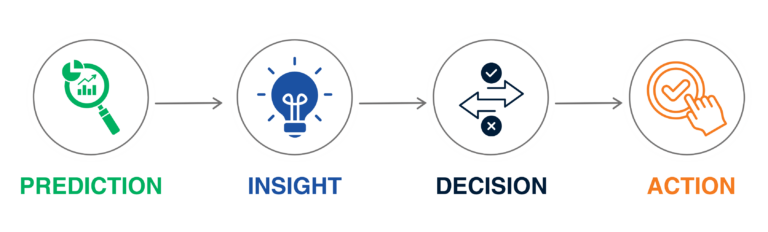
These are different operational situations, but they point to the same shift: prediction becomes valuable when it informs a decision before that decision becomes urgent.
These predictions can also feed into other YIS capabilities, such as intelligent decking and yard health monitoring, helping planners understand the potential downstream impact of changing conditions and adjust their strategy while options remain.
AI extends this approach, to act as a third arm for the planner, and as an augmentation layer that can process patterns, anticipate risks and support decisions at a scale that is difficult to achieve manually, all while keeping the planner at the center of the decision.
More time means more options, leading to better decisions.
The value of predictive intelligence isn’t prediction itself. It is the decision-making window it creates.
A few extra hours can change the nature of a planning decision: from finding a way around a constraint to choosing the response that best fits the operation.
That can mean avoiding a move rather than planning one, balancing resources before demand shifts, or adjusting a strategy while alternatives are still available.
The real advantage of foresight is not knowing exactly what will happen. It’s having room to respond when it does.
Seeing the problem coming is only the beginning
But foresight alone doesn’t make a yard more efficient.
Once planners have a clearer view of what may be ahead, the next challenge is deciding which response creates the best outcome particularly when one decision can affect space, equipment, vessel operations and the moves that follow.
That moves the conversation from “What is likely to happen?” to “What should we do about it?”
And that’s where the next part of the YIS story picks up.